

Trace line worksheets are valuable tools for early childhood, offering a fun way to develop crucial fine motor skills and prepare little hands for writing.
What are Trace Line Worksheets?
Trace line worksheets are specifically designed educational resources featuring various lines – straight, curved, zig-zag, and wave – that young children practice following with a pencil or crayon. These worksheets present pre-drawn paths that children trace, reinforcing hand-eye coordination and control.
Typically available as PDF downloads, these sheets offer a simple, engaging activity. They are foundational for pre-writing skills, helping children build the muscle memory and dexterity needed for letter and number formation. The bold lines make tracing accessible for beginners, and the repetitive nature builds confidence. Many free resources online provide a diverse range of tracing patterns, catering to different skill levels and interests.
The Importance of Tracing for Early Childhood Development
Tracing, facilitated by readily available trace line worksheet PDFs, plays a vital role in a child’s developmental journey. It’s a cornerstone for building fine motor skills, strengthening the small muscles in hands and fingers – essential for tasks like writing, buttoning clothes, and using utensils.
Beyond motor skills, tracing enhances hand-eye coordination, as children visually follow the lines while simultaneously controlling their hand movements. This process also lays the groundwork for letter and number recognition, preparing them for formal writing instruction. The focused concentration required during tracing also fosters patience and improves cognitive skills. These worksheets offer a playful, low-pressure environment for skill development.

Types of Trace Line Worksheets
Trace line worksheet PDFs encompass diverse designs, including straight, curved, zig-zag, and wave lines, each offering unique challenges to build essential motor skills.
Straight Line Tracing Worksheets
Straight line tracing worksheets represent the foundational step in developing pre-writing skills. These PDF resources typically feature horizontal, vertical, and diagonal lines, presented in varying lengths and thicknesses. The simplicity of these lines allows young children to focus on controlling the pencil and mastering basic hand movements.
These worksheets are excellent for beginners, as they require minimal coordination compared to curved or zig-zag lines. Repeated practice with straight lines builds confidence and strengthens the small muscles in the hand, preparing them for more complex tracing tasks. Many free trace line worksheet PDFs online offer a range of difficulty levels within straight line tracing, starting with dotted lines and progressing to fainter guidelines as the child’s skills improve. They are a cornerstone of early writing preparation.
Curved Line Tracing Worksheets
Curved line tracing worksheets build upon the skills developed with straight lines, introducing a new level of complexity and coordination. These PDF downloads often feature gentle arcs, semi-circles, and flowing curves, encouraging children to practice smooth, continuous movements. They are designed to enhance hand-eye coordination and refine fine motor control.
Compared to straight lines, curves demand more precision and control, helping children learn to navigate changes in direction. Free trace line worksheet PDFs frequently include variations in curve size and direction, providing progressive challenges. Mastering curved lines is a crucial step towards forming letters, as many letters incorporate curved strokes. These worksheets are a playful and effective way to prepare young learners for handwriting success, fostering both skill and confidence.
Zig Zag Line Tracing Worksheets
Zig zag line tracing worksheets present a unique challenge, requiring children to navigate sharp changes in direction. These readily available PDF resources feature lines that alternate between upward and downward angles, demanding greater control and precision than straight or curved lines. They are excellent for developing visual tracking skills and hand-eye coordination.
Free trace line worksheet PDFs often incorporate varying degrees of zig-zag intensity, offering progressive difficulty. Successfully tracing zig-zag lines strengthens the small muscles in the hand and prepares children for more complex writing patterns. This type of practice enhances motor planning and spatial awareness. The angular nature of zig-zag lines also helps build foundational skills for forming letters with pointed features, making them a valuable addition to early writing practice.
Wave Line Tracing Worksheets

Wave line tracing worksheets, easily found as PDF downloads, introduce a flowing, rhythmic element to pre-writing practice. These worksheets depict lines that undulate like ocean waves, requiring children to maintain consistent pressure and control as they follow the curves. They are fantastic for developing fluidity in hand movements and improving coordination.
Many free trace line worksheet PDFs offer wave lines of varying amplitude and wavelength, providing a graduated learning experience. Mastering wave lines builds the necessary dexterity for forming rounded letters and shapes. The continuous, flowing motion encourages a relaxed pencil grip and promotes endurance. These worksheets also subtly enhance visual perception skills, as children learn to anticipate and follow the curves. They are a delightful and effective way to prepare young learners for handwriting.

Benefits of Using Trace Line Worksheets
Trace line worksheets, often available as PDFs, boost fine motor skills, hand-eye coordination, and pencil grip – essential foundations for successful writing.
Developing Fine Motor Skills
Trace line worksheets, readily accessible as PDF downloads, are exceptionally beneficial for nurturing a child’s developing fine motor skills. These skills involve the precise coordination of small muscles in the hands and fingers, crucial for tasks like writing, drawing, and even self-care.
Tracing activities require children to control the pressure and direction of their writing tool, strengthening those tiny hand muscles with each stroke. The repetitive nature of tracing lines – whether straight, curved, or zig-zag – builds muscle memory and improves dexterity.
By consistently practicing with these worksheets, children gain greater control over their hand movements, setting a strong foundation for more complex writing tasks later on. This early development is a key component of pre-writing readiness and overall cognitive growth.
Improving Hand-Eye Coordination
Utilizing trace line worksheets, often found as convenient PDF files, significantly enhances a child’s hand-eye coordination. This vital skill involves the seamless communication between vision and hand movements, allowing for precise and controlled actions. Tracing demands focused attention, as children visually follow the lines while simultaneously guiding their hand along the path.
The act of tracing requires constant visual monitoring and adjustments, strengthening the connection between what the eye sees and what the hand does. Successfully completing a tracing worksheet provides a sense of accomplishment, reinforcing this coordination.
Consistent practice with these worksheets helps children develop the ability to accurately translate visual information into physical movements, a skill essential for various activities, including writing, drawing, and playing sports.
Enhancing Pencil Grip
Trace line worksheets, readily available as PDF downloads, are instrumental in developing a proper pencil grip. Early practice with tracing encourages children to adopt the dynamic tripod grasp – using thumb, index, and middle finger – crucial for comfortable and efficient writing. The controlled movements required for tracing naturally promote this grip, as opposed to a fisted or awkward hold.
These worksheets provide repetitive opportunities to refine grip strength and control. The clear lines offer a defined path, minimizing frustration and allowing children to focus on their hand position.
Consistent use of tracing activities builds muscle memory, making the correct grip feel more natural over time, ultimately setting a strong foundation for handwriting success.
Preparing for Letter Formation
Trace line worksheet PDFs serve as a foundational step towards letter formation, bridging the gap between basic motor skills and pre-writing abilities. Tracing straight, curved, and zig-zag lines builds the necessary muscle memory and hand-eye coordination required to replicate the strokes that compose letters.
By mastering these fundamental lines, children begin to understand directionality and spatial awareness – essential concepts for forming letters correctly. The repetitive nature of tracing reinforces these skills, making the transition to letter writing smoother and more intuitive.
Worksheets often subtly incorporate elements of letter shapes, preparing children for recognizing and reproducing those forms.

Where to Find Trace Line Worksheet PDFs
Numerous online resources offer free printable trace line worksheet PDFs, alongside customizable generators allowing tailored content creation for diverse learning needs.
Free Printable Resources Online
The internet is brimming with websites dedicated to providing free, downloadable trace line worksheet PDFs. These resources are fantastic for parents, teachers, and caregivers seeking accessible learning materials. Many sites offer a variety of tracing patterns, including straight lines, curved lines, zig-zag lines, and wave lines, catering to different skill levels and developmental stages.
Several platforms host extensive collections of these worksheets, often categorized by difficulty or theme. You can easily find options suitable for toddlers just beginning to explore pencil control, as well as more challenging designs for preschoolers refining their fine motor skills. A quick search will reveal options like “Tracing Lines Worksheet” and “Back to School Tracing” readily available for instant download and printing. These free resources eliminate the need for expensive workbooks, making early learning affordable and convenient.
Customizable Worksheet Generators
Beyond pre-made PDFs, several online tools empower you to create personalized trace line worksheets. These generators offer a higher degree of control, allowing you to tailor the worksheets to your child’s specific needs and interests. You can often adjust parameters like line complexity, font styles, and even incorporate custom text or images.
These generators typically operate through a user-friendly interface where you select desired options and then download the finished worksheet in a preferred format – PDF, PNG, or JPG. This flexibility is particularly beneficial for addressing individual learning challenges or reinforcing specific skills. The ability to customize ensures the worksheets remain engaging and relevant, maximizing their effectiveness in developing fine motor skills and preparing children for letter formation.
Using Trace Line Worksheets Effectively
Maximize learning by selecting age-appropriate worksheets and offering encouragement. Integrate tracing with other playful activities to foster a positive learning experience;
Age Appropriateness and Worksheet Selection
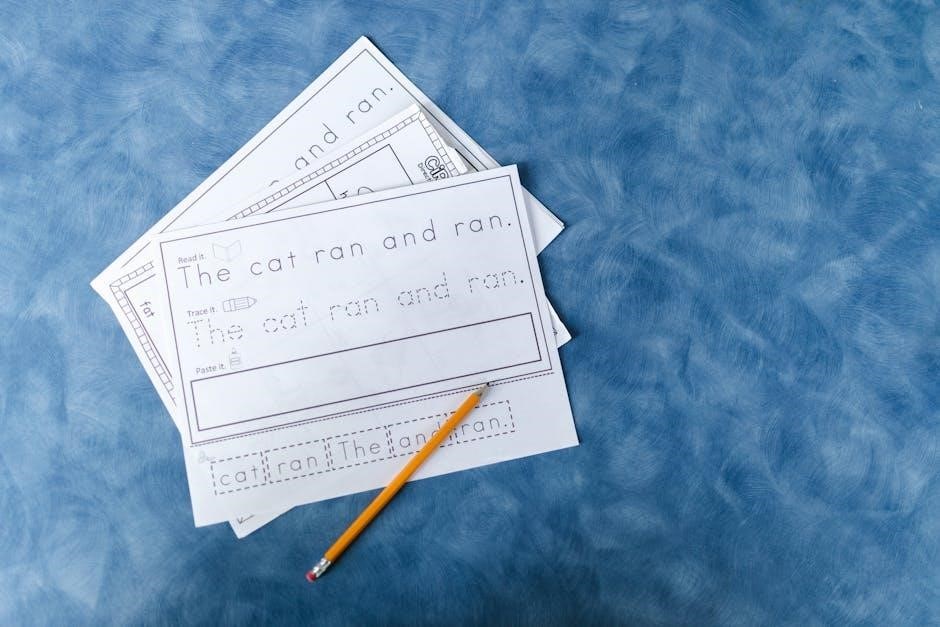
Choosing the right worksheets is paramount for a successful tracing experience. Start with simple, straight lines for younger children, around ages 3-4, focusing on building basic control. As they progress, introduce curved lines and then more complex patterns like zig-zags and waves for children aged 4-5.
Consider your child’s individual skill level; some may grasp concepts quicker than others. Observe their pencil grip and coordination. If they struggle with control, revert to simpler exercises. Worksheets with bold, clear lines are easier to follow initially.
Don’t overwhelm them with too many lines on a single page. A few well-executed traces are more beneficial than a rushed attempt at many. Printable PDFs offer a variety of options, allowing you to tailor the difficulty to your child’s needs, ensuring a positive and productive learning session.

Tips for Encouraging Children
Make tracing fun! Transform practice into a game by using colorful markers or crayons instead of just pencils. Offer positive reinforcement and praise effort, not just perfect results. Celebrate each completed worksheet with enthusiasm.
Keep sessions short and sweet, especially for younger children, to maintain their attention. Integrate tracing with other activities – for example, trace lines to create a path for a toy car.
Avoid pressure and allow children to explore at their own pace. Printable PDF worksheets provide flexibility; you can easily reprint favorites or adjust the difficulty. A relaxed and supportive environment fosters confidence and a love for learning, making tracing a positive experience.
Integrating Worksheets with Other Activities
Extend the learning beyond the page! Use completed trace line worksheets as inspiration for creative art projects. Children can color the traced lines, turning simple exercises into vibrant pictures. Incorporate tracing into sensory play – trace lines in sand or shaving cream for a tactile experience.
Connect tracing to pre-writing skills by having children copy the traced lines independently. Build a story around the lines, encouraging imagination and narrative development. Printable PDF worksheets are easily adaptable; use them as part of a themed learning unit, like “Back to School” or seasonal activities.
These integrated approaches reinforce skills and make learning more engaging and memorable.
File Formats: PDF, PNG, and JPG
Trace line worksheets are commonly available as PDF, PNG, or JPG files, offering flexibility for downloading, printing, and use across various devices.
Understanding the Differences
PDF (Portable Document Format) is ideal for preserving formatting, ensuring the worksheet prints as intended, regardless of the user’s operating system or software. It’s excellent for high-quality printing and sharing, maintaining a consistent look. PNG (Portable Network Graphics) offers lossless compression, meaning no image quality is lost, and it supports transparency, useful for worksheets with varied backgrounds. However, file sizes can be larger than JPGs.
JPG (Joint Photographic Experts Group) uses lossy compression, resulting in smaller file sizes, making it quicker to download and share online. While convenient, some image detail may be sacrificed. For trace line worksheets, PDFs are often preferred for print quality, while PNGs and JPGs are suitable for online viewing or digital activities. Choosing depends on your primary need – print fidelity or file size/sharing ease.
Choosing the Right Format for Your Needs
If your priority is printing high-quality trace line worksheets for a classroom or home, PDF is the optimal choice. It guarantees the lines will be crisp and clear, preserving the intended design across different printers. For sharing worksheets online, particularly via email or websites, JPG offers a good balance between image quality and smaller file size, facilitating faster downloads.
If you need a format that supports transparency or requires lossless compression to maintain intricate details, PNG is preferable. Consider your audience’s access to software – PDFs require a PDF reader, while JPGs and PNGs are widely viewable. Customizable worksheets benefit from PDF’s format retention. Ultimately, select the format aligning with your distribution method and desired visual outcome.

Paper Size Options: A4 vs. US Letter
Trace line worksheet PDFs commonly come in A4 (210 x 297 mm) or US Letter (8.5 x 11 inches) sizes; choose based on your printer’s compatibility.
Selecting the Correct Size for Printing
Ensuring the correct paper size when printing trace line worksheet PDFs is crucial for optimal use. Most worksheets are designed for either A4 (210 x 297 mm), the standard size in many countries, or US Letter (8.5 x 11 inches), prevalent in North America.
Before printing, verify your printer settings to match the worksheet’s intended size. Selecting the wrong size can result in content being cut off, appearing too small, or being misaligned. Many PDF viewers allow you to check and adjust the page size within the print dialogue box.
If you’re unsure, test print a single page first. This allows you to confirm the worksheet fits the paper correctly and that all lines are fully visible. Adjust the scaling options if needed to achieve a perfect fit. Proper sizing ensures a positive and frustration-free tracing experience for young learners.